
The way society negatively perceives itself does not just come from our family or friends, but also from our televisions. For years, the media has played a role in the way people are socialized to gender and race stereotypes, often in ways we don’t realize. For instance, beauty and make-up advertisements primarily portray women, and have done so before everyone had a television in their home. So, it is no surprise that it is still difficult for some people to accept that men can wear make-up as well.
In the same way, the media (social media, television shows, etc.) plays a major role in society’s racial bias or perception of racial roles. This not only bleeds into the way we look at each other, but also how we approach relationships.
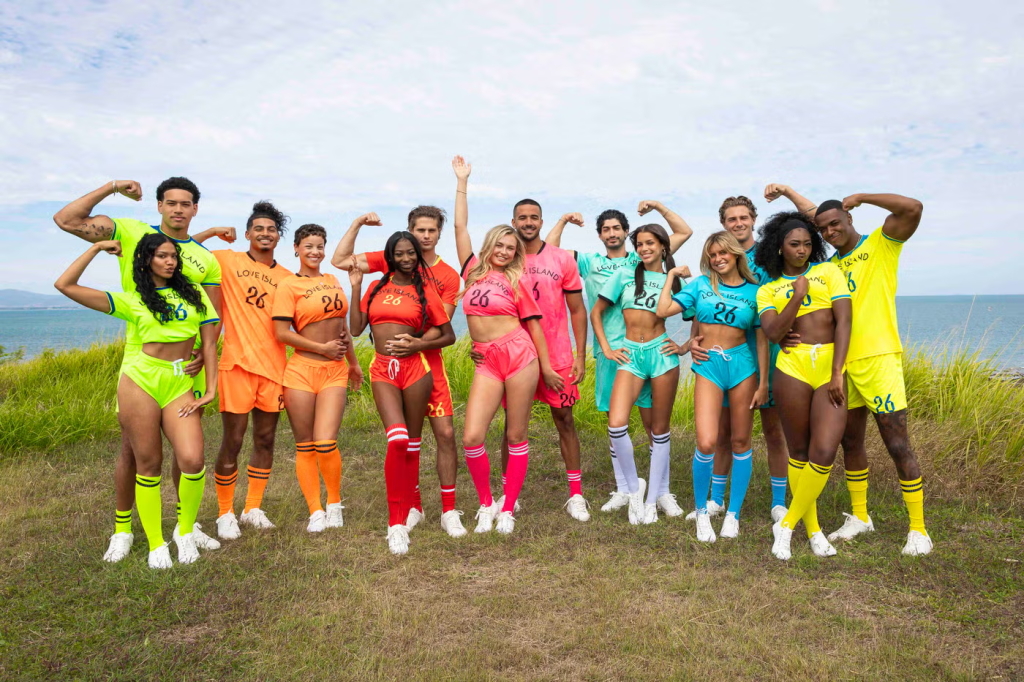
As one of the millions of people in America who watched Love Island this summer, I did so as an escape from the real world. However, as the show went on and I witnessed Trinity Tatum’s cries and heard of Alannah Keyser’s questionable behavior in her past, it was no longer an escape from the real world.
It became painfully obvious that parts of the media had become a kind of “revolving door” for racial bias, especially in terms of relationships; the same shows that influenced racist behavior of Love Island contestants and made Trinity Tatum have fear surrounding her interracial connection were shows just like Love Island.
I: A Short History of Media and Racial Bias
The history of racial bias and negative stereotypes from the newspapers to reality television has left Black people oversexualized, and has particularly left Black women feeling as if they are the “second option.” Black women have been perceived as a “token” by the media—as if they are solely a pretty object to possess—instead of a person. Or, they are perceived as less than another race. Or both.
For example, look at JaNa Craig’s experience of season six of Love Island. Craig told AP, “The very first time I felt special was when the very first guy picked me because he had three options. Other than that, I always felt like I was getting the short end of the stick…we still felt like — not good enough.”
JaNa Craig’s case also explored a different consequence of problematic race roles in relationships. While Craig was a runner-up on season six of Love Island, her partner, Kenny Rodriguez, was accused of racist comments toward JaNa and of exploiting her to boost his own career. His alleged actions are not only racist but also dehumanize JaNa as a person, as if she were merely a stepping stone.
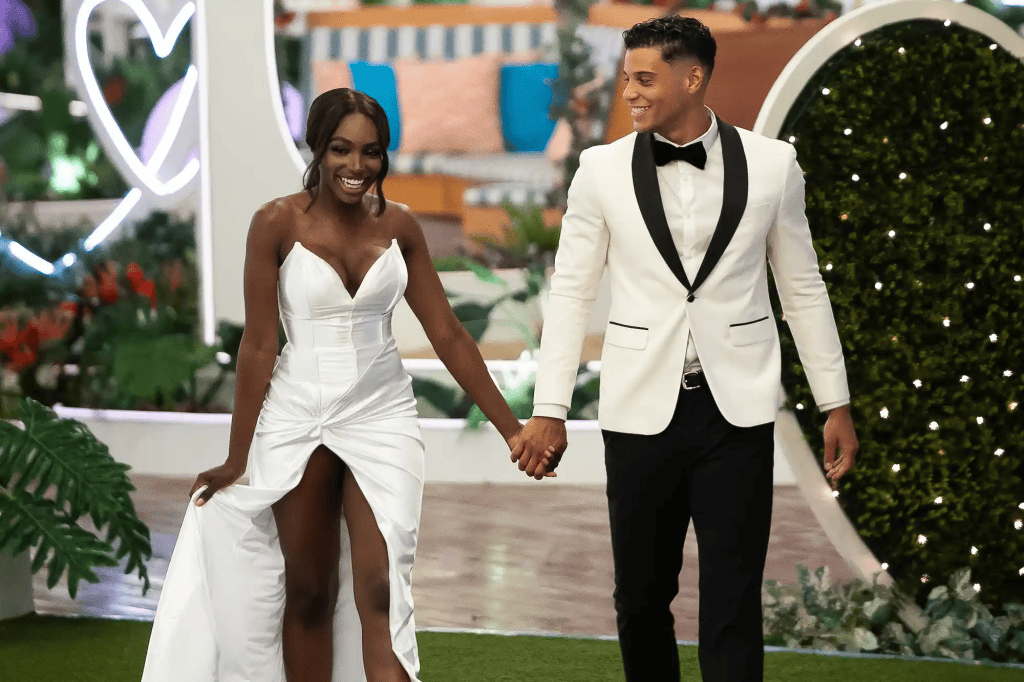
While Rodriguez has since denied Craig’s claims, the story still made the headlines and that was enough to do some damage. Subsequently, Craig’s story reinforced itself as another piece of media that altered the perspective of the Black woman. Not only from the perspective of others, but from the perspective of herself.
II: Tales of a Black Woman
As a Black woman, watching JaNa Craig’s story triggered a little sense of fear within me that had always been at the back of my mind. Dating another race had always imposed a fear that racist behavior would become a problem in the relationship. Not necessarily in the obvious sense, where you fear your partner will call you a slur (though this too can be a legitimate concern and is a point on Love Island). It’s mainly the little things.
It’s feeling like you are perfect, but yet, because you are Black, you are not enough in your partner’s eyes. It’s the feeling that your partner may think that someone that looks nothing like you is more suitable. This was a fear that was never taught to me directly, but has always been here, within me. And for season eight winner Trinity Tatum, that fear was apparent in her too.
In the clip, Tatum fears her connection, Bryce Alakai, will choose someone of a lighter shade during Casa Amor, almost equating being lighter with being more desirable. While it’s clear that she doesn’t agree with the sentiment, the belief still lives within her. Why could this be?
Reality TV (and society in general) have pushed the notion that white women are more desirable than Black women. It could even be argued that in Love Island there have been cases where a man has preferred a white woman over a woman who is Black. In season eight of Love Island USA, some noticed the behavior of Corbin Mims, displaying a sour expression towards Anyia Harvey (black woman) during one of the challenges, an expression he didn’t express when interacting with Kenzie Annis (white woman) during the same challenge.
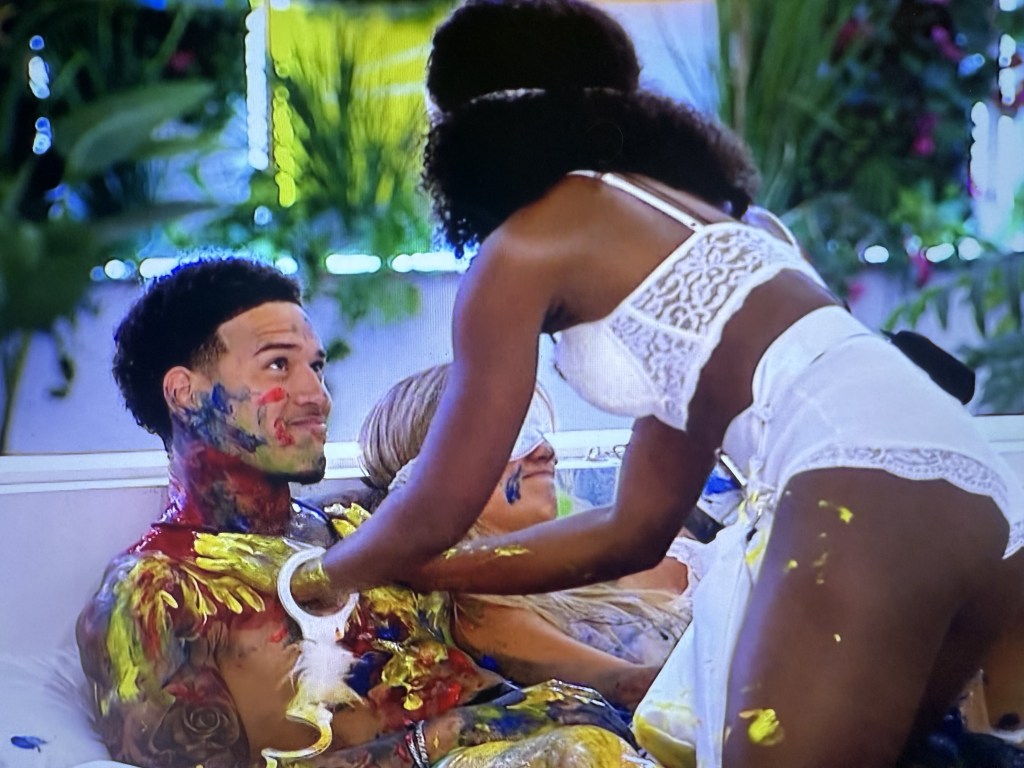
It should be noted that we do not know exactly what Mims was thinking during that challenge. Also, Reality TV can be manipulated and edited in specific ways to push a narrative. Still, with this context, it only makes the situation more convoluted.
If we are not clearly addressing the question of desirability of Black women in the eyes of the racist media, then we are still trying to find where people draw the line between attraction and fetishization, or preference and discrimination.
III: Black Men in Reality Television
Because we’ve been looking at the way the media affects the racial bias for Black women, it’s important that we touch on how it also affects Black men.
The media has spent years fetishizing Black men, perceiving them as beings that are more “sexual” or “powerful” than white men. These traits are pushed to the forefront of the narrative in the media in a way that makes it seem like those are the Black man’s only characteristics.
In season eight of Love Island USA, Corbin Mims was often perceived as the “big, strong, bad boy,” and nothing more. While all the girls kept referring to how big and tall Mims was, Kenzie Annis, the first girl he officially coupled up with, always seemed to exacerbate his physical characteristics.
She kept repeatedly bringing up his “big hands,” at one point stating, “I got a guy who got that has big hands…and you know what that means” (Season 8, Episode 6).
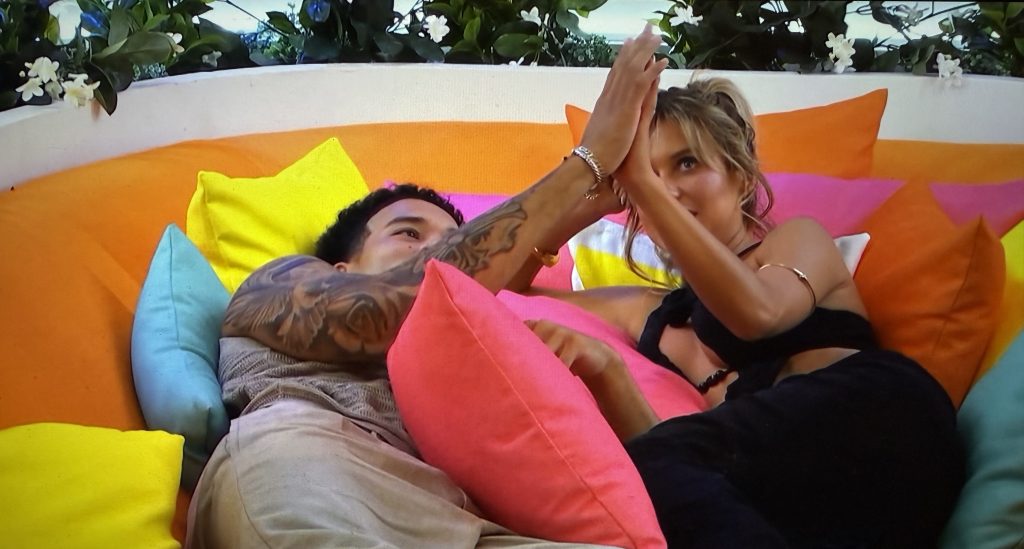
In the next couple of episodes, she kept referring to him in an overtly sexual manner, more than she spoke of him as a person.
A few episodes later, everyone in the villa was put in a challenge to see what each islander thought of each other. There was a question about who was most likely to ghost someone, and the girls chose Mims as the guy they thought best fit that prompt.
When asked how he felt about being chosen, he said, “This is the s*** I hear all–my whole life. Just how I look. It is what it is” (Season 8, Episode 9).
While Mims said that how he thinks he looks is “Good,” his previous statement emphasized what one of the girls had said earlier. Their reasoning for choosing him was because he was a city boy and he looks like a bad boy. And throughout the media, light-skinned men have gotten the reputation of being toxic or evil time and time again.
And while it may seem lighthearted or a joke on social media or in reality television, these are the same narratives that find a way into people’s systems of thinking and can be regurgitated into a negative context.
On the other side of the same coin, the media has worked to discriminate against Black people for years. Going back to before the Jim Crow era, racist depictions of Black people have been circulated around America. In the history of Love Island, racism has proved to be a problem, too. In past seasons, contestants have been kicked off the show for racist remarks. In season eight, one islander was kicked off a little too late for the damage to be undone.
Alannah Keyser came into Love Island in season eight during Casa Amor. In the very short time she had on screen, fans noticed that she displayed adverse behavior during one of the scenes in the show.
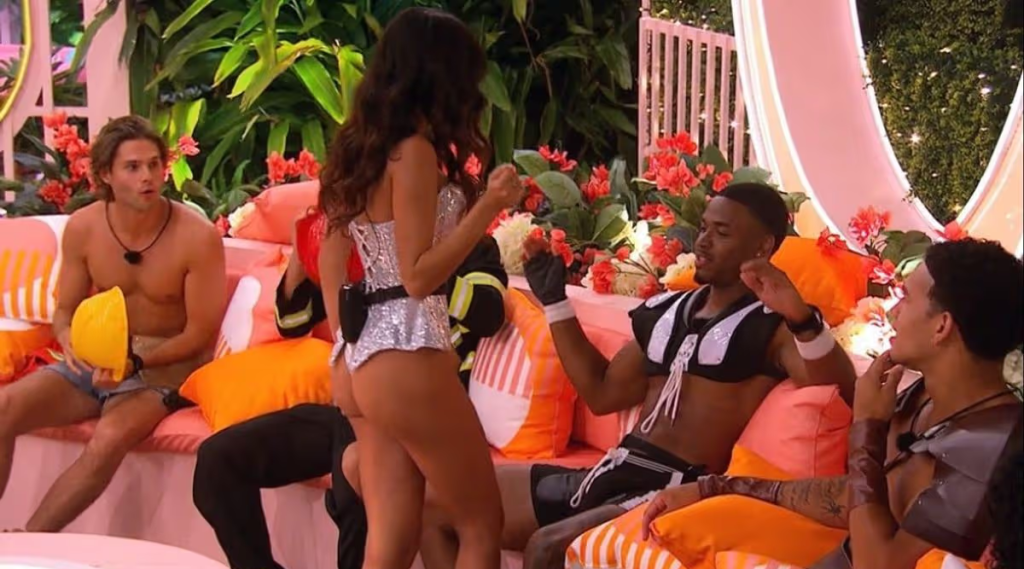
During the activity, the new Casa Amor girls went around kissing all the boys from the Villa. When it’s Alannah’s turn, she fully kisses everyone except the people of color (Season 8, Episode 17). Upon watching, the choice may simply seem off-putting. However, upon the news that she had used racial slurs on social media in the past, it is hard to look past her decision as not racially motivated.
IV: We Don’t Realize Until It’s Too Late
We still do not know what Alannah Keyser was thinking when she decided she didn’t want to entertain the men of color during the activity. We also don’t know if Kenzie Annis intended to fetishize Corbin Mims. With that said, even if they didn’t mean to act with racial bias, that doesn’t mean that their actions were not problematic. And, in this case, it’s even harder to ignore the consequences of some Islanders’ behavior when everyone is talking about it. This is how the “revolving door” starts.
Through internet comments, social media posts, and reality television, people can get socialized into the beliefs they hold onto today. Those same people share or act on their beliefs on the internet and on reality television shows for more people to hear. Then the people listening start to inherit those beliefs; or, in other words, the revolving door opens once again.
Most of all, when we are socialized to believe certain things by the media, we may not even realize that we hold those beliefs or prejudices. However, by the time we exhibit our beliefs, sometimes it’s too late before we have affected someone else.
While we don’t have the power to stop the media from producing content, we do have the power to do one thing: reflect and think before we act.


