
There is a thrill to placing a bet. There’s anticipation, a churning feeling in the stomach as one waits to see how much they won or lost. In most cases, people go to casinos to experience such a thing, but with the growth of online sports betting apps, the feeling and the risks are right on our phones, just one click away; we don’t even have to leave our couches. It sounds almost to good to be true, so what’s the catch? The main catch is that nobody really wins.
I: The Detrimental Marketing
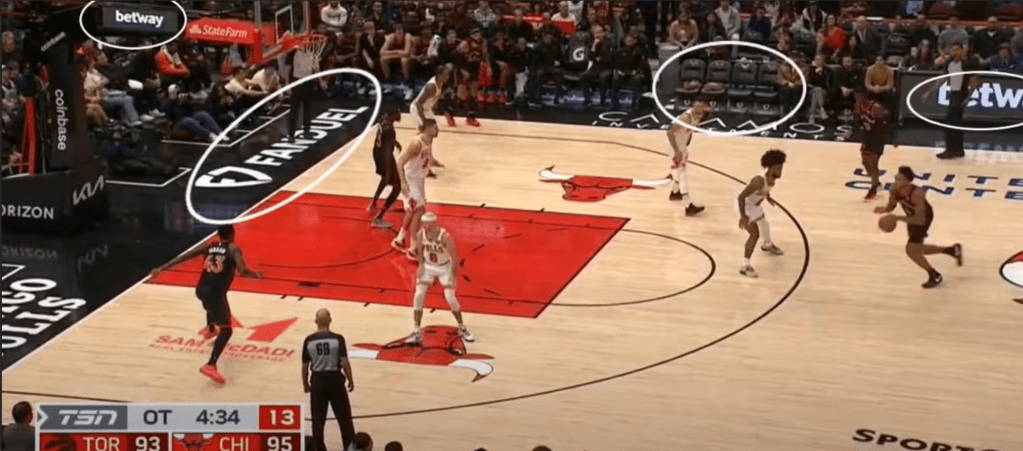
If you watch sports, or even if you don’t, you’ve probably seen advertisements from online sports books like FanDuel, BetMGM, and DraftKings everywhere you turn — literally everywhere you turn. They put themselves on jerseys, billboards, social media, broadcasts, podcasts, basketball courts, dasher boards, and in plenty of commercials. Besides the multitude of advertisements shown, what makes up an ad can also draw in new users. A line of research from the Journal of Current Addiction Reports shows marketing companies use overall ideals and themes to promote online sports gambling. Three of the themes found in the study included bright colors and humor, the idea that sports gambling is a skill-based activity, and that gamblers are winners.
When someone takes a gamble, being a winner —or a loser—isn’t guaranteed. However, for the ones who do win, staying a winner isn’t guaranteed either. DraftKings user Beau Wagner talked to the Washington Post after he went to X (Twitter) with a photo of his $50,000 ticket printed onto a canvas.
After the post and DraftKings’ support of the win, Wagner found he was limited to how much money he could wager. First, it was $100. A few days later, he couldn’t even wager $5.
“The major problem I have is that DraftKings used my ticket to make it seem like you can win big, just like they do in their commercials,” Wagner told the Washington Post. “You promote my tweet, and literally the next morning, I’m limited.”
The promotions can be seen by anyone, including problem gamblers, uneducated adults, young adults, and kids, all people who are more vulnerable to falling for sports books’ persuasion. And the people who do, the ones who download the apps thinking it’ll just be an easy way to make money or a fun hobby, are coxed even further by push notifications. The push notifications and the continuation of frequent sports betting advertising make gamblers take increased higher-risk bets. This can make a bettor lose significant amounts of money and can also lead them down the road to addiction and mental decline.

“It was just the temptation of sports betting, you know, all the ads. I’m not going to say that the ads are the reason I did it, but just constantly being reminded of it,” an anonymous teen admitted to GMA.
Another man told CBC News, “It’s hard not to be drawn to make a bet if you have the app.” When asked why, he said, “Because it’s just right there.”
II: To the Gamblers
It’s evident environmental factors, like commercials, play a role in people’s repetitive usage of online sports books. But it’s the biological factors that can cause casual gamblers to become problem gamblers. An article provided by Timothy W. Fong, MD, at UCLA Health, discusses how gambling links to dopamine receptors, a reward system in the brain. If a gambler wins one time, they’ll keep coming back, hoping to replenish that high. Or if one thinks, “If I keep on betting, I can win today,” they’ll reopen the app every day with the idea that it’ll be the day they win. According to the American Physiological Association, when one compulsively craves and needs to gamble more often to feel satisfied is the point at which it becomes an addiction.
An addiction to sports gambling can lead to other mental health issues, like depression and anxiety. According to a paper in the Journal, Addictive Behaviors, sports bettors, particularly ones that used the cash-out feature offered by sports books, were seen to have mental health issues linked to betting. Bettors reported increased substance use and feelings of sadness, anxiety, and stress.
A current study from Lia Nower, director of the Center for Gambling Studies at Rutgers University in New Jersey (referred to in How gambling affects the brain and who is most vulnerable to addiction), points to sports bettors being at higher risk of developing mental health issues and being more likely to become problem gamblers. In the study, Nower and fellow researchers found that 14% of sports bettors reported suicidal thoughts, and 10% reported they made a suicide attempt.
III: To the Teams
One of the most overlooked consequences of sports betting is how it mentally affects athletes and coaches. NBA players like Jayson Tatum and Tyrese Haliburton and former Cavaliers coach J. B. Bickerstaff have stated how sports betting has negatively affected them without touching a sports book.
Jayson Tatum, a forward for the Boston Celtics, talked to the media at practice a few weeks ago, saying, “I guess when you hit people’s parlays and do good, they’ll tell me, but they’ll also talk shit if I’m on the court and didn’t get them 29 at half or whatever I was supposed to do.”
“I guess I do feel bad when I don’t hit people’s parlays. I don’t want them to lose money.”
Tyrese Haliburton, a point guard for the Indiana Pacers, also mentioned sports bettors’ thoughtlessness in a question from the media regarding his choice to see a sports psychologist. Haliburton mentioned that with the popularity of sports betting, he feels like a prop.
“Not everybody cares to hear how we feel…I mean, to half the world, I’m just helping them make money on DraftKings or whatever. You know what I mean? I’m a prop,” he expressed.
The negative dominoes fall onto the coaches, too. Following Haliburton’s comments, J. B. Bickerstaff, the former Cleveland Cavaliers coach, told reporters that sports betting adds an extra level of pressure and distraction to players. He also stated that he had seen firsthand how consequential sports betting can be for everyone.
“There’s no doubt about it that it’s crossed the line,” Bickerstaff stated.
“The number of times I’m standing up there, and we may have a 10-point lead, and the spread is 11, and people are yelling at me to leave the guys in so that we can cover the spread, it’s ridiculous…[A gambler] got my telephone number and were sending me crazy messages about where I live and my kids and all that stuff.
He then added, “A lot of times, the people who are gambling like this, money pays their light bill or their rent, and then the emotions that come from that. So I do think we’re walking a very fine line, and we have to be extremely careful in protecting everybody who’s involved.”
IV: Pot of Gold
On the BetMGM app, all it takes is four simple steps to place a bet. Being careful is difficult when spending hundreds of dollars within minutes is so easy. A survey done by NerdWallet shows that those who participate in online sports betting spent an average of $1,934 over the last 12 months (equates to about $161 a month). According to a poll by Statista, the majority of gamblers surveyed (about 21%) spent less than $50 a month. But, the same poll said that nearly 18% of gamblers spent $250 to $499 a month.

Putting hundreds of dollars down with no guarantee you’ll get it back in full is more dangerous than it is beneficial. For the average person, that is too much money to risk. It’s also a lot of money that sports betting companies receive. At the end of 2023, Americans wagered $119.84 billion. Of that money, the sports betting industry collectively racked up $10.92 billion in revenue, according to the American Gaming Association. But where are these billions? The United States Census Bureau says that the dollars that are generated in tax revenue go to funding roads, highways, public education, the police, and gambling addiction programs.
Funding public resources is important, but is it to happen at the cost of people’s well-being? Are we going to rely on gambling money to support gambling addiction programs? Is it right to let the sports betting industry go unpunished because funding the economy matters more than people’s lives?
The innocent people who get influenced by indifferent sports books and the people whose mental health is impacted, those people matter. Because very quickly, they could be your friendly neighbor, they could be you, or someone you love. And when you’re watching it take someone you love, I wonder how much the entertainment, economy, or “easy money” will matter then?
If you or anyone you know needs help and support, visit https://www.ncpgambling.org or call 1–800-GAMBLER.
SAMHSA’s National Helpline is also available at 1–800–662-HELP

 My Little Musings...